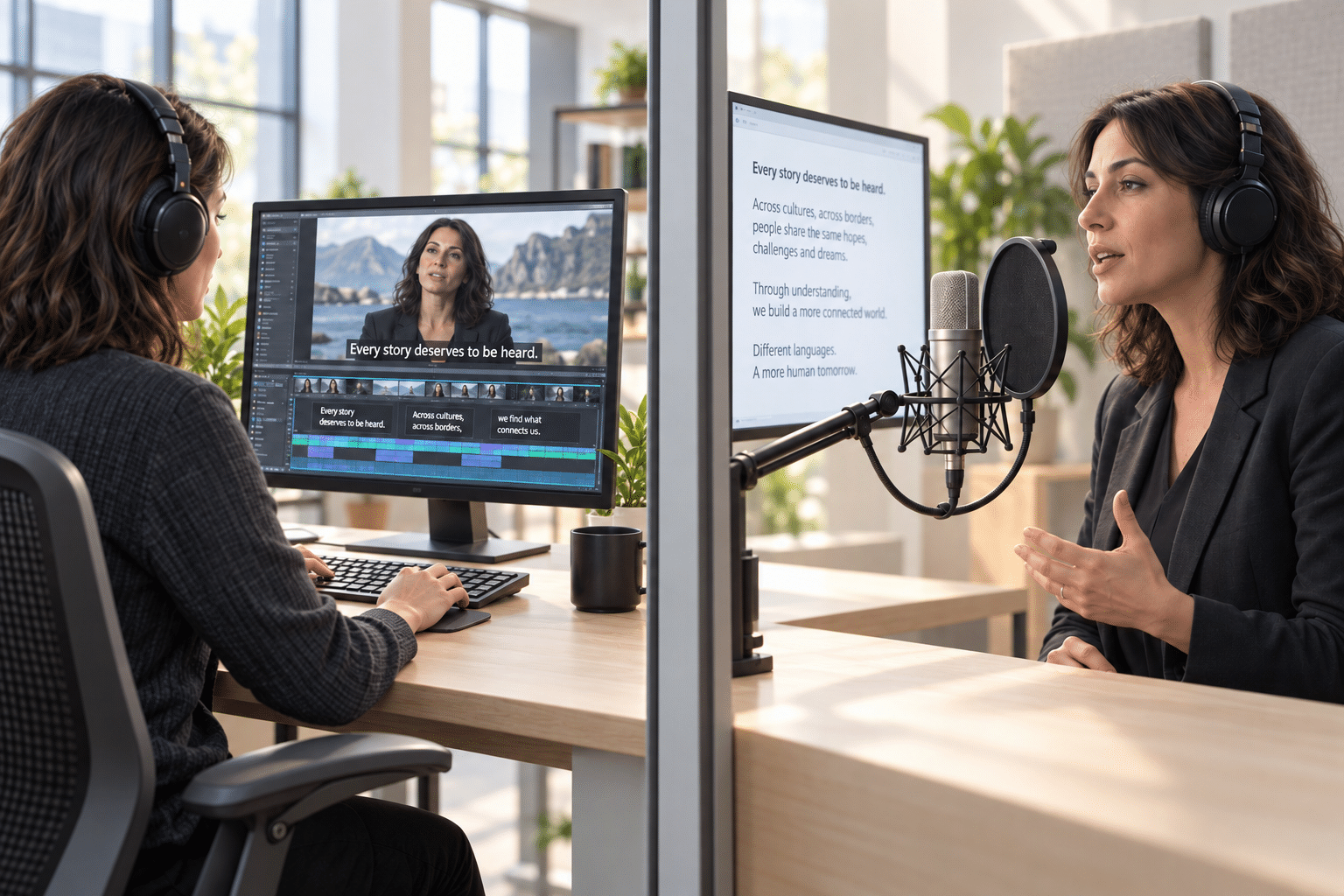
TL;DR: Start with what your audience needs to understand, rather than choosing a service by name. Subtitles show spoken dialogue as text; SDH/accessibility captions also identify speakers and describe important sounds. Voiceover and dubbing provide translated speech, while audio description (AD) explains relevant visual information for blind and visually impaired viewers. You may need more than one service. You don’t need to settle every technical detail upfront: use this guide to identify your priorities, then agree the timing, delivery files and usage rights with your provider before commissioning.
“We need voiceover.” “Can you add subtitles?” Both sound like straightforward requests, yet each can describe very different services. For multilingual video, visitor experiences, training, corporate comms and cultural content, that ambiguity can mean inaccurate quotations, unsuitable workflows and unexpected costs.
We typically work on integrated campaigns that bring together several types of content, but the right approach isn’t necessarily the same for every video. Start with what your audience needs to read, hear and understand – not simply the name of a service. Is the content dramatic, instructional or informational? That context helps shape the experience you brief.
Helping you navigate the complexity
Voiceover, dubbing, subtitles, captions and audio description are related, but they’re not interchangeable. The criteria below will help you choose the right combination and brief your provider clearly.
You don’t need to know all the terminology before you begin. Start with the comparison table to identify the services that may suit your audience. The sections that follow explain the choices around timing, accessibility, delivery, costs and usage rights, and the checklist helps you bring those decisions together in a clear brief. If you’d like more detail along the way, you’ll find service definitions, examples and technical options at the end of the article.
1. Choose what your audience needs to read and hear
Find the audience need that best matches your video in the left-hand column, then read across to see which service to discuss and what to clarify with your provider. More than one row may apply: for example, you may need translated speech alongside subtitles or accessibility captions. Use the table as a starting point, rather than a choice of just one service.
| Audience need | Service to discuss | What to confirm |
|---|---|---|
| Read spoken dialogue in the same or another language | Standard subtitles | Dialogue-focused text; confirm reading, timing and platform requirements. |
| Read dialogue and relevant sound information | SDH (subtitles for the Deaf and hard of hearing)/accessibility captions | Include speaker identification, meaningful sounds, music and other necessary audio information. |
| Hear narration, explanation or translated commentary | Voiceover/narration | Agree whether it adds commentary or replaces narration, and how closely it follows the picture. |
| Hear a translation while retaining the original speaker’s voice in the background | UN-style voiceover | The original remains faintly audible beneath a translation timed to the speaker. |
| Hear a target-language performance in place of original dialogue | Dubbing | Agree fit-to-duration or closer lip sync, plus casting and performance direction. |
| Hear relevant visual information described | Audio description (AD) | A separate accessibility service for blind and visually impaired audiences, using suitable dialogue gaps. |
2. Decide how closely translated speech must match
Will viewers see the people speaking? If so, decide whether the translated speech only needs to fit the original sequence or must match visible mouth movements more closely. The answer affects adaptation, casting, direction, recording and editing.
- Narration or voiceover: agree how closely the new speech must follow the on-screen action and original timing.
- UN-style voiceover: retain the original voice faintly beneath the translated voice, which starts shortly afterwards and finishes at roughly the same time.
- Fit-to-duration dubbing: fit a natural target-language performance within the original speech window without necessarily matching every mouth movement.
- Lip-sync dubbing: adapt more closely to mouth movements, rhythm and pauses. This can require more work and increase costs; closer synchronisation may be reserved for prominent facial close-ups rather than every scene.
3. Decide what accessibility information viewers need
Dialogue translation and accessibility are separate decisions. For on-screen text, agree whether viewers need dialogue alone or SDH/accessibility captions with speaker identification and meaningful sound cues. For blind and visually impaired audiences, consider audio description of relevant visual action in suitable gaps between dialogue.
For subtitles and captions: decide whether the text should be permanently visible (open) or switchable by the viewer (closed). Then confirm the platform’s file format and timing requirements. Detailed terminology, display styles and examples are in the reference sections below.
4. Agree the delivery files and who finishes the video
For subtitles, confirm whether your platform needs SRT, VTT or another file format. Our guide to subtitling takes a closer look at SRT files and the workflow behind accurate, consistently styled subtitles.
Why dubbed audio and subtitles may need different wording
If you need both dubbed audio and subtitles, one approved translation may provide the starting point, but each version needs its own adaptation. You may not need two separate translations from scratch. Sometimes the same wording works for both; elsewhere, a subtitle needs shortening or a dubbed line needs a different spoken construction.
The two versions share a source but serve different purposes. Dubbing prioritises natural speech, performance, characterisation, speaking duration and synchronisation. Subtitles prioritise reading speed, line length, segmentation, screen duration and readability.
For voiceover and dubbing, the delivery choice is different: do you need audio files for your team to integrate (like a WAV file), or a finished language version with full layback?
WAV-only: the supplier delivers edited, named and timed foreign-language dialogue files for your production team to integrate.
Full layback: foreign dialogue is synchronised and mixed with supplied music-and-effects material, technically checked and delivered as a finished language master.
You’ll also need to agree who will handle the final audio mix. This includes balancing the translated dialogue with music and effects so speech remains clear, and checking that the finished soundtrack meets the platform’s audio requirements.
Before requesting a quote, check whether you can supply a clean music-and-effects (M&E) track or suitable separate audio stems. These provide the material needed beneath replacement dialogue. Without clean assets, replacing original speech can be harder and more expensive.
5. Compare the audio scope, costs and usage rights
For voiceover and dubbing, compare quotes against the same scope: cast size, actor minimums, finished duration, the synchronisation and direction required, pickups, licensing and post-production. These choices shape the price, so confirm what each quote includes before comparing totals.
Licensing and usage rights
Before recording, agree where, how and for how long the voice performance can be used. Make sure the agreement covers your intended platforms, territories and usage period, and check the terms for renewals or reuse in other campaigns. Don’t assume permission to use a recording also covers voice cloning or AI training: address these uses separately and explicitly.
6. Pre-quote checklist
Source material
- Is there a definitive spoken transcript?
- Are final or near-final videos available?
- Are suitable M&E tracks or stems available?
Translated speech and performance
- Is the requirement narration, UN-style voiceover or character dubbing?
- Is fit-to-duration sufficient, or is closer lip sync required?
- Which characters and spoken sections need to be localised?
- Are supporting, incidental and crowd voices included?
Subtitles and accessibility
- Do you want standard dialogue subtitles or SDH/accessibility captions?
- Should subtitles/captions be open or closed?
- Are foreign-language subtitles required as well as dubbed audio?
- Is audio description required, and does the AD script need to be created?
Delivery and approvals
- Is WAV-only delivery sufficient, or is full layback required?
- Who approves voice casting?
Usage rights and AI consent
- What usage period, territory and media are required?
- Are AI-generated or cloned voices being considered, and what consent/licensing applies?
Define the experience, then commission the service
The right approach starts with the experience you want to create, not a service label. Agreeing that vision early helps avoid unnecessary revisions and gives your production team a clear brief for a natural, accessible final result. We’d love to learn more about your project. To discuss the next stage, send us your video or available source material, tell us about your audience and what you want to achieve, and share your checklist answers – even where a decision is still open. We can help you work out the right combination of services.
