Most translation agencies will tell you they follow a “quality assurance process”. But if you’re responsible for signing off multilingual content, that still leaves one key question: how do you know if a translation is actually good – especially if you don’t speak the language?
In reality, translation quality isn’t just about grammar or spelling. It’s about whether the content works, makes sense in context and reflects what the content says.
This guide gives you a practical checklist you can use to evaluate translation quality whether you’re reviewing a supplier, switching agencies or approving content across multiple markets.
What “quality” actually means (in simple terms)
Most professional frameworks break translation quality down into a few core areas:
- Accuracy – Does it say the same thing as the original?
- Fluency – Does it read naturally?
- Consistency – Are key terms and phrases used correctly throughout?
- Fitness for purpose – Does it work for the intended audience?
That’s useful, but it doesn’t help much when you’re looking at a translation and trying to decide if it’s good. So instead of theory, here’s what to actually check.
The translation quality checklist
Use this as a practical sign-off tool – even if you don’t speak the target language.
1. Completeness: Does anything look missing?
- Do the structure and layout match the original?
- Same number of headings, bullet points, sections?
- Any obvious gaps or missing paragraphs?
➡️ Missing content is one of the most common QA failures – and often the hardest to catch later.
2. Terminology consistency: Are key terms handled properly?
- Are product names, features, or legal terms consistent?
- Do repeated phrases appear consistently translated?
➡️ In high-quality workflows, this is controlled using glossaries and briefing – not left to chance.
3. Tone and intent: Does it feel right for the audience?
- Formal vs informal tone consistent?
- Does it sound like a professional piece of content – or a literal translation?
➡️ This is especially critical for marketing, UX, and client-facing content.
4. Formatting and localisation details
- Dates, currencies, and numbers adapted correctly?
- Layout preserved?
- Any text cut off, misaligned or visually broken?
➡️ These are simple checks, which can be caught relatively easily with a fresh pair of eyes.
5. Red flags (even if you don’t speak the language)
You can still spot issues by looking for:
- Translations significantly longer or shorter than the original (always allow for text expansion with some languages like French/German of around 15-20%).
- Repeated or duplicated text
- Odd punctuation or formatting inconsistencies
➡️ These are often symptoms of deeper quality or software issues.
6. Independent review: Was it checked by a second linguist?
This is one of the most important quality indicators.
- Was the translation reviewed by a second, independent linguist?
- Ideally, someone with subject-matter expertise?
➡️ This is standard in professional workflows (and required in ISO-aligned processes). The standard is called ISO 17100, and we align our processes with it.
What ISO 17100 means for translation quality
ISO 17100 is the international standard for professional translation services. For buyers, its value is that it focuses on the process behind the translation: qualified linguists, clear project management, revision, traceability and final checks before delivery.
One of the most important principles is that a translation should not simply be completed by one person and delivered unchecked. In an ISO 17100-aligned workflow, the translation is reviewed by a second qualified linguist, separate from the original translator, to check meaning, terminology, consistency and fitness for purpose.
In practical terms, you can ask a translation provider:
- Who translated the content?
- Who revised it?
- Were both linguists suitably qualified for the subject matter?
- How were terminology, context and client feedback managed?
- Is there a clear process for queries, review and corrections?
The key point is that ISO 17100 should not be treated as just a badge. What matters is whether the agency can show how those principles are applied in practice, especially on complex, multilingual or business-critical projects.
7. Context fit: Does it work where it will be used?
- Website content vs UI vs legal vs technical content
- Does it match the environment it will appear in?
➡️ This is where many issues appear – especially in software and UX.
8. Ask for evidence
A strong agency should be able to show:
- QA checks or reports
- Question logs (queries raised during translation)
- Evidence of revision steps
➡️ If quality is real, it should also be traceable.
What most agencies don’t tell you about QA
Many agencies will say they “proofread” or “check quality.”
But that can mean very different things.
- Is it just a spell-check – or a full bilingual review?
- Is the reviewer independent – or the same person checking their own work?
- Are real questions being raised – or just assumptions being made?
➡️ Translation quality isn’t just a step at the end. It’s the result of how the entire process is managed.
Where quality really comes from
In practice, quality is driven by how well questions are handled, not just by how carefully the text is reviewed. On complex projects, it’s normal for issues to emerge: terminology may be ambiguous, context may be missing, changes may arrive late in the process, and certain wording may need to follow a client’s internal preferences or established style.
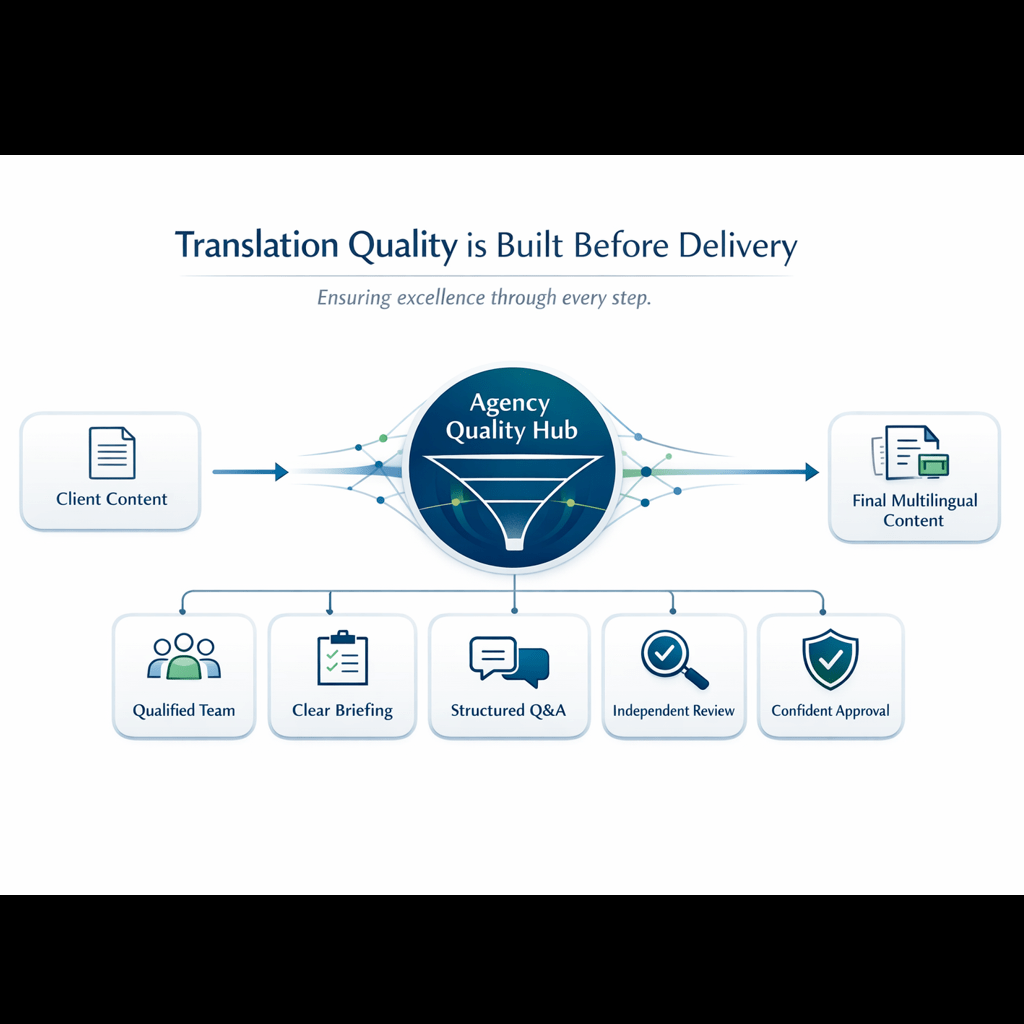
The difference is how those issues are managed. A strong process gives linguists a structured way to raise questions, consolidates those questions into a clear feedback loop, resolves decisions consistently across all languages, and applies the agreed answers in a controlled, traceable way.
This becomes critical when managing large multilingual projects – sometimes involving dozens of linguists and multiple revision stages.
The agency’s role: more than just a messenger
A strong translation agency does more than assign the work and wait for delivery. It builds trusted relationships with linguists, briefs them properly at the start of the project and gives them the confidence to raise questions when something is unclear. Behind that process is something less visible but just as important: a qualified team that shares the same standards, values and commitment to the client’s success.
Those questions shouldn’t reach the client as a scattered stream of comments. They need to be reviewed, consolidated and managed through a clear question-and-answer process. Where the agency already understands the client’s content, terminology and subject matter, it can often resolve issues directly. Where clarification is genuinely needed, it can liaise with the client in a focused way and then apply the answer consistently across the translation and revision process.
This is where agency experience really matters. An agency that understands the content can act as an informed filter, not just a messenger. It can protect the client’s time, support the linguists properly and reduce the risk of unresolved ambiguity making its way into the final translation.
Example: Why context matters (technical + UI examples)
Technical
In a technical project, something as basic as power plugs caused confusion:
- European systems: plug in and use
- UK systems: require you to operate a switch and the plug has an internal fuse – which will need to be tested or replaced in the event of a product not working
Without understanding the product context, this would be translated incorrectly.
Instead, the content had to be adapted to suit the local market, not just translated.
UI
Another common issue appears in user interface content:
- The same word (e.g. “accept”) can have different meanings depending on context – such as ‘accept’ a friendship request or ‘accept’ a contract.
- Translation tools often assume repeated text should be translated the same way
- But in UI, context changes meaning – often very abruptly as strings can be grouped together
Without careful review, those distinctions are lost.
With the right process:
- Context is reviewed
- Questions are raised and resolved
- Consistency is applied intentionally – not automatically, so your translation team needs to ensure that auto-propagation is turned off and have a system in place to deal with contextual use.
Translation quality isn’t just about language.
Good translation quality is rarely the result of language skill alone. It depends on the process behind the work: how well the brief is understood, how much context is available, how clearly linguists can raise questions and how consistently issues are handled before they become problems for the client.
The best translation partners don’t just deliver content; they give you the confidence that what you’re approving is accurate, consistent and fit for purpose – even across multiple languages and complex projects.
If you’d like, we can review your existing translations or QA process and highlight where risks might sit before they become problems. Just get in touch.
