“Can you translate this into French, German, Spanish or another language?” – is typically the starting point of any conversation, but it doesn’t reveal what the content needs to do in the target language. Whereas some material simply needs to transfer meaning accurately, other content might need to sound natural, persuade an audience, reflect a brand voice or work within a specific cultural context.
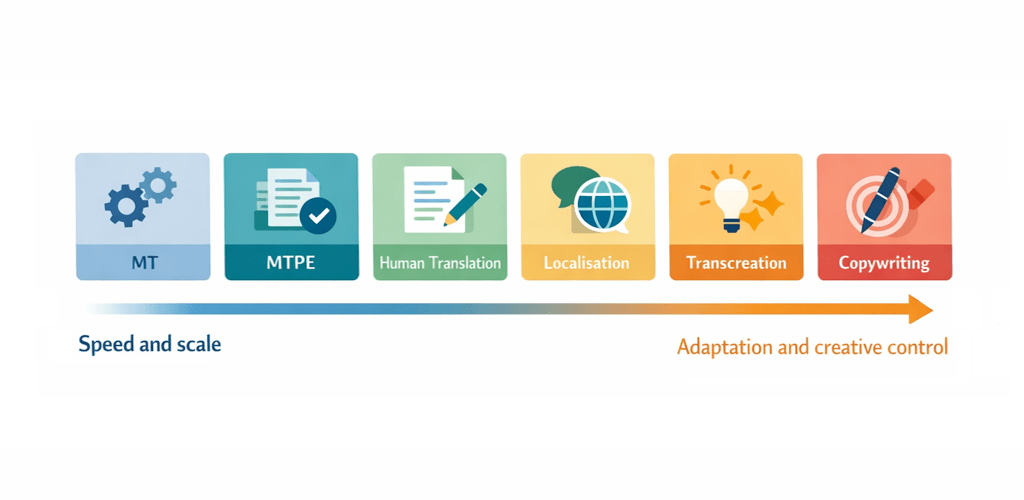
In other words, we might get asked for a “translation”, but the right solution may involve translation, localisation, transcreation or target-language copywriting, depending on the role the content plays.
This is often where clients may have run into trouble in the past with their projects simply because the agency they used didn’t ask or assumed the wrong purpose. The content can be translated, but if the audience, purpose and desired impact are not defined early enough, the result may be technically correct yet ineffective, inconsistent or poorly aligned with the people it’s meant to reach.
For example, a website page may be faithfully translated but sound unnatural to local buyers; machine-translated product information may create inconsistent terminology across markets; campaign copy may preserve the literal meaning but lose the tone, emotion or persuasive force that made it work in the original language.
That’s why we start with the question: “What does this content need to achieve in the target language?”
That question sits at the heart of our briefing process. Once the answer is clear, the workflow becomes much easier to define.
For experienced language professionals, this assessment starts as soon as we review the copy. We map the content to its audience: who will read it, what they need to understand, how they are likely to respond and what the client wants them to do next. The strategy then follows from that diagnosis and is agreed with the client as part of the brief.
But let’s first take a brief look at what the terms behind ‘translation’ mean.
Translation, localisation, transcreation and copywriting: what’s the difference?
Before choosing a workflow, it helps to clarify a common source of confusion: not all “translation” is the same.
At a basic level:
- Translation focuses on transferring meaning accurately from one language to another.
- Localisation adapts content so it feels natural and appropriate for a specific audience or market.
- Transcreation reshapes messaging more creatively, preserving intent while adapting tone, style and impact.
- Copywriting creates original content directly for the target audience, using the right message, tone and structure to inform, persuade or drive action
Sometimes translating the original text is not enough. Content that needs to persuade, engage or reflect a brand voice may need deeper adaptation, or even new copy written directly in the target language.
This distinction matters because the workflow you choose depends not just on the language, but on the role the content plays.
But what about MT and post-editing? Where do they fit?
Machine translation and post-editing are not adaptation levels in the same way as translation, localisation or transcreation. They describe how the work is produced and reviewed. Adaptation levels describe what the content needs to become in the target language: accurate, natural, persuasive, brand-aligned or newly created.
That is why MT and MTPE are best considered later in the workflow decision. Once you know the level of adaptation required, you can decide whether automation, post-editing, human translation, localisation, transcreation or copywriting is the right way to deliver it.
Start with the purpose, not the service
The most effective language workflows don’t begin with a service such as translation, localisation, transcreation, copywriting, MT or MTPE. They begin with the content’s purpose, audience and risk level. To illustrate what we mean, we’ve broken down content into three basic levels.
Level 1: Internal reference and support-only content
At the lowest-risk level is content used mainly inside the organisation: reference material, internal documentation or operational resources that are not intended for external audiences.
The main goal is clarity. If the source content is straightforward and the consequences of minor imperfections are limited, a faster workflow may be appropriate, especially where volumes are high or turnaround is tight.
Some control is still needed. If internal content supports processes, decisions or technical understanding, inconsistent terminology or unclear wording can still create confusion and rework.
Level 2: Operational and semi-visible content
The next level covers content that sits between internal use and public communication: knowledge bases, product information, onboarding materials, support content and customer-facing guidance.
This content may not be marketing-led, but it still shapes user experience and trust. It usually needs stronger terminology control, clear review responsibilities and consistent treatment across languages.
The workflow should reflect where the content will appear, who will rely on it and how much confidence users need to place in it.
Level 3: High-visibility and brand-critical content
At the highest-risk level is content that directly shapes perception, persuasion or reputation: websites, campaigns, video scripts, reports, thought-leadership pieces and other brand-critical material.
Here, accuracy is only the starting point. The content also needs to sound natural, reflect the intended tone, suit the market and support the action you want the audience to take. That often calls for localisation, transcreation or target-language copywriting rather than straightforward translation alone.
As content moves up the ladder, the question changes from:
Is this accurate? to Does this work as intended for this audience, in this market?
From content risk to workflow choice
The higher the impact on perception, trust or decision-making, the more deliberate the workflow needs to be.
Timing is part of that decision. Tight deadlines reduce the room available for review, iteration and adaptation, so speed needs to be designed into the workflow from the start.
Where speed matters, it should be supported by clearer source content, agreed terminology, defined review responsibilities and realistic feedback timelines.
The full spectrum of language services
Once purpose and adaptation level are clear, you can choose the right production route. This is where MT, post-editing, human translation, localisation, transcreation and copywriting each have a role.
Machine translation (MT): fast and scalable, but with limited control and limited suitability for nuanced or brand-sensitive content.
MT + post-editing (MTPE): scalable with structured human input to improve accuracy, fluency and terminology control – check out our article on editing depth and linguistic validation for further info.
Human translation + revision: higher control, stronger consistency and better suitability for customer-facing or regulated content.
Localisation and transcreation: adaptation for audience, culture, tone and market context.
Target-language copywriting: content created directly for the market when adaptation is no longer enough.
Many projects combine these routes, especially when different content types sit within the same campaign, website or documentation set.
Blog content is a good example. A technical explainer may need accurate translation and terminology control, while a thought-leadership article, landing page or campaign-led post may need deeper adaptation so it sounds natural, persuasive and aligned with the audience.
UI and app content is another fluid example. Menu labels, error messages and help text may need concise, consistent translation with strict terminology control, while onboarding screens, empty states, notifications and upgrade prompts may need localisation or transcreation so they feel intuitive, natural and motivating in each market.
Where workflows break down
Even strong workflows can break down when the brief, source content or review expectations are unclear.
This often happens when the source material is weak, the brief is incomplete or too much responsibility is placed on automation. Problems also arise when every content type is pushed through the same workflow, even though a technical document, support article and campaign page may each need a different level of control.
These issues can cause more delay and rework than the translation itself.
The real trade-offs: speed, cost, control and adaptation
Every workflow involves trade-offs between speed, cost, control and adaptation.
Automation can increase speed and scale, but it needs the right checks in place to maintain quality and control, such as a clear brief, terminology guidance and appropriate review. Human-led workflows increase control and consistency, but require more time, coordination and stakeholder input.
As content becomes more visible, persuasive or brand-sensitive, the need for adaptation increases. Faster workflows usually mean less review depth, fewer revision cycles and less creative development, so the trade-off needs to be explicit from the start.
Speed is rarely determined by translation alone. Delivery also depends on source quality, terminology readiness, review structure, stakeholder alignment and feedback turnaround.
A strong workflow moves efficiently through content preparation, translation or adaptation, review, feedback and approval. Where any stage is missing or poorly defined, delays and inconsistencies are more likely.
A practical decision framework
Use the framework below to match content purpose, risk and visibility with the most appropriate workflow. It’s not a rigid rulebook, but a way to match content purpose, risk and timeline with the right level of linguistic control.
Which workflow fits your content?
| Content type | Primary goal | Recommended approach | Speed considerations | Key risks if misaligned |
| Internal reference | Clarity | MT | Fastest, minimal review | Confusion from poor source |
| Operational content | Consistency | MTPE | Fast with structured review | Inconsistent output |
| Customer-facing | Accuracy | Human translation | Moderate, review-dependent | Terminology or quality gaps |
| Market-specific content | Relevance | Localisation | Moderate to slower, market-aware review | Content feels unnatural or poorly adapted |
| Brand-critical | Impact | Transcreation | Slower, iterative | Message loses tone, emotion or persuasive force |
| Marketing | Engagement | Copywriting | Slowest, creative process | Message fails to resonate |
Choosing well starts before production
There is often no single best translation workflow. The right choice depends on the content’s purpose, audience, visibility and required level of control.
The strongest results come from planning that workflow before production starts. Speed, quality and control are not added at the end; they are designed into the process through the right brief, the right level of adaptation and a clear review and feedback structure.
Need help choosing the right language workflow?
If you’re unsure which workflow fits your content, we can review your material, identify the level of translation, localisation, transcreation or copywriting it needs, and design a practical workflow that balances quality, scale, speed and control. We’d love to have a chat.
