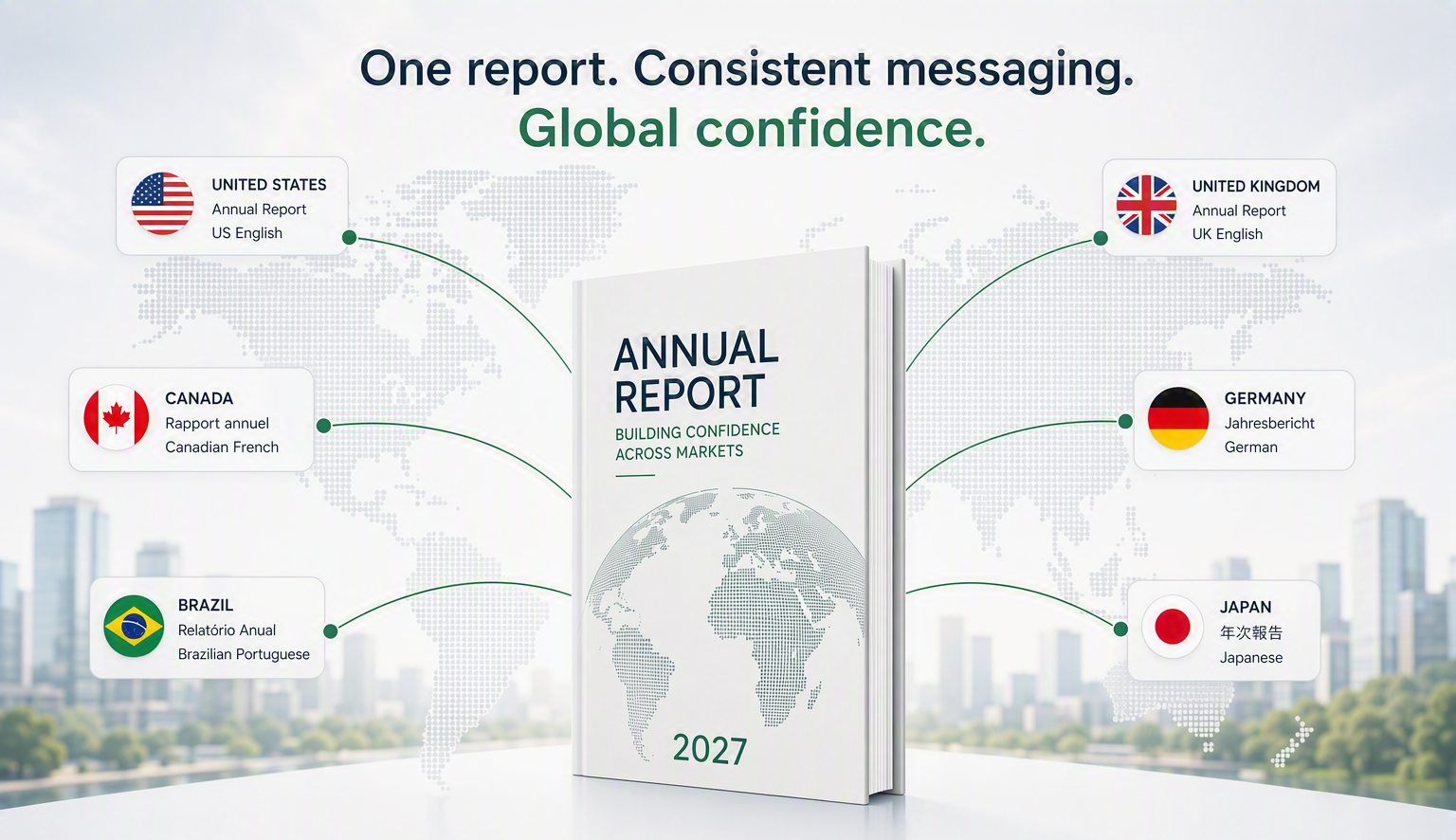
Annual reports are no longer simply compliance documents. They’re investor-and public-facing narratives that explain performance, strategy, governance, risk and long-term value creation in one carefully managed publication.
That makes annual report translation a specific discipline within corporate reporting. The figures have to be exact, but so does the surrounding story: the chair’s statement, strategic review, sustainability narrative, risk language and outlook all shape how overseas investors understand the organisation.
Before translation begins, the briefing stage identifies where the report needs to stay close to the source text and where the target language may need a more natural investor-relations style. This is especially important when a tone that works in English would sound overly promotional or casual in another market. It’s especially critical when translating into English. That’s because the opposite can be true in other languages like German, which prefers formal, passive language which won’t translate well into English without a degree of transcreation.
Annual report translation has to balance two kinds of accuracy
In an annual report, some content calls for near-literal precision. The governance section with its figures, notes, accounting terms, risk disclosures and statements, leaves little room for adaptation, softening or rewriting.
By contrast, the strategic section works differently. Leadership commentary and ESG narratives need to carry the same intent, confidence and judgement as the original, while reading naturally for the audience in question.
The challenge is knowing which parts of the report require strict fidelity and which require controlled adaptation. Treating every page in the same way can make the translation either too rigid to persuade or too loose to reassure.
Plan around publication, not just translation
The first question is not simply “what languages do we need?” but “how will each version be used?”
A translated annual report for publication, investor relations or board circulation needs a different workflow from an internal reference version. Some projects require bilingual review, financial terminology checks, sign-off by local teams and final proofreading once flown into the final design.
Making that decision early saves time, money and effort further down the line. It helps you assign the right reviewers, build in enough time for comments and prevent late-stage changes from creating inconsistencies across language versions.
Annual reports also tend to move through design software, reporting platforms or structured publishing systems. Text expansion, chart labels, non-editable graphics and last-minute source updates – not to mention interview delays and sign-off bottlenecks that slow everything down – all affect the translation process, so file format and layout implications as well as foreseeable holdups should be discussed before the first page is translated.
Reporting continuity is part of the message
Annual reports are rarely written from a blank page. They often draw on previous reports, sustainability disclosures, investor presentations, governance statements and agreed corporate language.
That history matters in translation. A term used one way last year should not drift without a reason, and recurring commitments should remain recognisable unless the company has deliberately changed its wording.
Translation memories, terminology lists and previous approved reports therefore do more than speed up production. They help maintain comparability for investors, reduce repeated review queries and protect the company’s voice across reporting cycles.
Small layout details can change how the report is read
Annual reports are dense, highly designed publications where language and layout are closely connected. Tables, chart labels, notes, cross-references and page references all need to stay throughout the translation and layout phases.
A strong translation can still be undermined if a figure is separated from its caption, a heading no longer matches the section below, or a translated phrase overflows in a designed spread. Final layout review is therefore part of the quality process, not a finishing touch.
For wider reporting programmes, we help organisations translate annual reports, ESG content, stakeholder communications and related corporate materials with structured workflows that support accuracy, consistency and faster sign-off.
If the annual report forms part of a broader stakeholder reporting programme, our guide to smooth report-translation projects explains how early preparation can protect deadlines and reduce review pressure. For reports with substantial ESG or sustainability content, a separate review of claims, terminology and stakeholder language can help keep those sections accurate and credible, as detailed in our article.
A translated annual report should give overseas readers the same confidence
Annual report translation works best when it is planned as part of the reporting calendar, with clear decisions on purpose, audience, review stages, terminology and final layout checks.
The aim is not only to reproduce the English report in another language but to give overseas investors, partners and stakeholders the same confidence in the numbers, the narrative and the organisation behind them.
Preparing a multilingual annual report? Contact us early so we can help you build a translation process that supports investor confidence, reporting consistency and publication deadlines.
