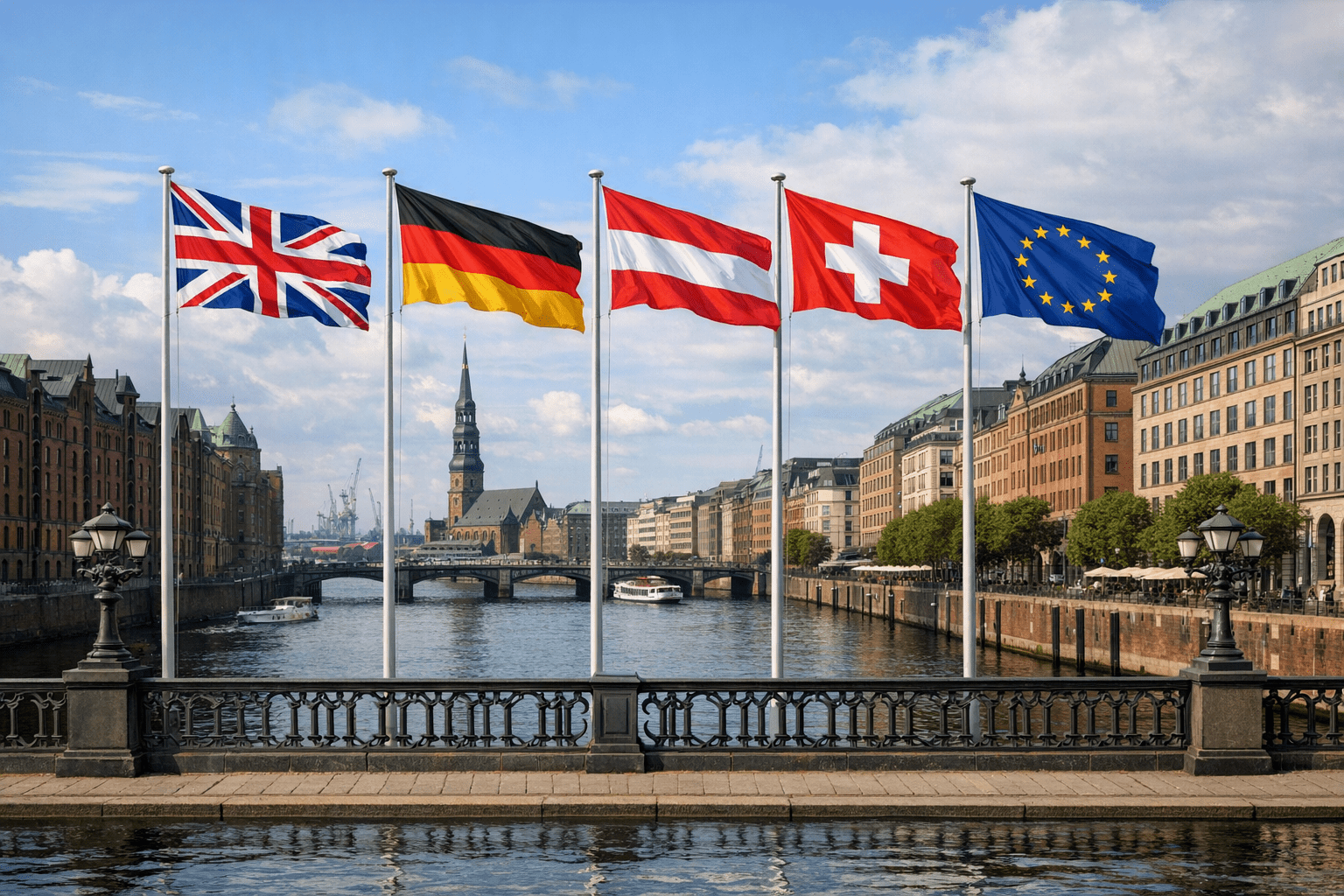
German has a reputation for long words (think Rindfleischetikettierungsüberwachungsaufgabenübertragungsgesetz), long sentences and punchlines that only make sense once the verb finally lands at the end of a sentence. But behind the jokes is a serious point for UK businesses: German doesn’t just translate differently – it often thinks, structures and persuades differently too.
Germany remains one of the UK’s most important trading partners, making German a priority language for many businesses looking to sell, inform or build trust in German-speaking countries (Germany, Austria and Switzerland) – or the DACH region as it’s also known.
But effective German content rarely comes from direct translation alone. If you want your messaging to work, you need to consider tone, structure, cultural aspects and audience expectations before you translate anything.
You’ll also need to decide whether you need a version tailored specifically to Germany, Austria or Switzerland, or whether one carefully briefed German version can work across all three markets (but even then, there may be aspects that won’t work entirely in Swiss or Austrian German – more on this below). That decision depends on how local the content needs to feel, and how much terminology, regulation or cultural context varies between markets.
Let’s dive in/los geht’s.
The core issue: direct translation isn’t always effective
English and German do not simply use different words; they often build meaning in different ways. English relies heavily on word order, prepositions, active voice and idiomatic phrasal verbs such as “look up to”, “run into” or “set out”. German, by contrast, uses case endings, compound nouns and more explicit grammatical relationships to carry meaning. That means a direct word-for-word translation can quickly become awkward, bloated or even grammatically incorrect. Tone also needs careful handling: what sounds warm and engaging in English can sound vague or insincere in German, while German precision can feel overly formal or dense if translated too literally back into English. Check out our article on localising your website for international audiences for an example of how German prefers a less pressure-driven tone for certain website elements.
The goal is not to replicate the wording; it’s to achieve the same outcome for the reader: confidence, understanding and a clear next step.
Here are some examples:
- English often leads with the main point, then adds supporting detail. German can be more comfortable building context first before arriving at the key point.
- English business writing tends to favour shorter sentences and a more direct flow, while German often allows longer, more layered sentences with more subordinate clauses.
- English marketing copy may sound natural when it’s concise, conversational and benefit-led, whereas German readers may expect more explicit explanation, especially in technical, financial or regulated contexts.
- English often uses punchy headings and standalone claims, while German may require those claims to be supported more clearly to avoid sounding vague, exaggerated or too sales-led.
- English can rely on implication, assuming the reader will infer the next step or benefit. German content often works better when relationships between ideas are made more explicit.
It’s one reason why simply translating using a machine-translation (MT) system like Google or DeepL or even poorly managed use of computer-aided translation (CAT) tools like Trados or Phrase can fall short. The output may be grammatically acceptable, but it often follows the structure of the source text too closely. Effective German translation requires a more critical approach, drawing on localisation, transcreation or copywriting techniques, so the content works for the intended audience.
Audience shapes language choices
Before translating, it’s critical you consider the audience for your content.
Technical specialists, regulators, customers and investors all need different levels of terminology, explanation and evidence. That’s particularly important in sectors where precision and credibility shape whether a reader trusts the content.
You may even need your content to speak to a different audience altogether, which may mean changing the level of detail, the terminology used or the way key messages are framed (this is achieved through a process called transcreation – keep reading for further info).
The role of formality
One area where English and German frequently diverge is tone.
Many UK businesses favour a conversational style, while German business communication often remains more formal, structured and explicit. It’s something we touched on in our article on annual financial report translations, where it’s essential it’s made clear how different the tone will be – and to secure the client’s agreement.
Finding the right balance helps your content feel credible in German rather than simply converted from English.
Translation versus localisation and transcreation – or even copywriting
Sometimes the words themselves are only part of the challenge. Measurements, formatting conventions, references, product claims and calls to action may also need adapting for local audiences. If geographic references are not handled carefully, they can weaken relevance and create post-editing work that should have been avoided during the briefing or text-analysis stage.
Things to watch out for when localising your copy include:
Currency symbols
In English, they go in front of the figure; in the DACH region and Europe in general, they follow the figure as shown below.
Separators
Replace decimal points and commas in English for commas and full stops – or even apostrophes.
| UK/US | Germany |
| 1,000 | 1.000 |
| 12,500 | 12.500 |
| 1,234,567 | 1.234.567 |
| 1,234.56 | 1.234,56 |
| €1,234.56 | 1.234,56 € |
Swiss formatting can vary by language and context, with Switzerland often using an apostrophe for thousands 1’234.56 rather than 1.234,56.
Punctuation
Speechmarks and inverted commas that have been left in their English format are another telltale sign of a poorly localised translation:
For German-language content, quotation marks are different:
„Guten Tag“, sagte er.
or in Switzerland:
«Guten Tag», sagte er.
A grammatically correct translation is important, but localisation and transcreation goes further by considering whether the content feels (and looks) natural, relevant and credible in the target market.
If you’re unsure whether your content needs translation, localisation, transcreation or even copywriting, our guide can help you understand the options – and we’re always happy to advise before you brief the work.
Making your messaging work in German
German translation isn’t simply about language accuracy; it’s about making sure your messaging works for German-speaking readers.
The sooner you consider audience, tone and localisation, the more effective the final content is likely to be.
Your action plan
Before you translate into German:
- agree who the content is for
- decide how formal or conversational it should sound
- identify whether the structure needs reshaping rather than directly translating
- check whether terminology, claims or sector-specific wording need closer control
- confirm whether formats such as numbers, currencies, punctuation and measurements need adapting
- decide whether one German version is suitable or whether separate versions are needed for Germany, Austria or Switzerland
- brief the translator on the intended outcome, not just the source text
- clean up your document, removing any unnecessary spaces, since you’ll be charged if the project is costed on a normed line basis of 55 words per line incl. spaces
If you’re planning to translate content into German, we can chat through your objectives and recommend the most suitable approach before the project gets underway.
