Choosing a translation agency is rarely just a procurement decision – it’s a trust decision.
In most cases, you’re translating into languages your team doesn’t speak. That means you’re relying on someone else to make judgement calls on technical accuracy, tone, nuance and meaning – often without you being able to validate those choices internally.
That’s why the best translation agencies don’t simply deliver words; they act as partners – guiding you through decisions, flagging risks early and ensuring the final output represents your brand accurately across every market.
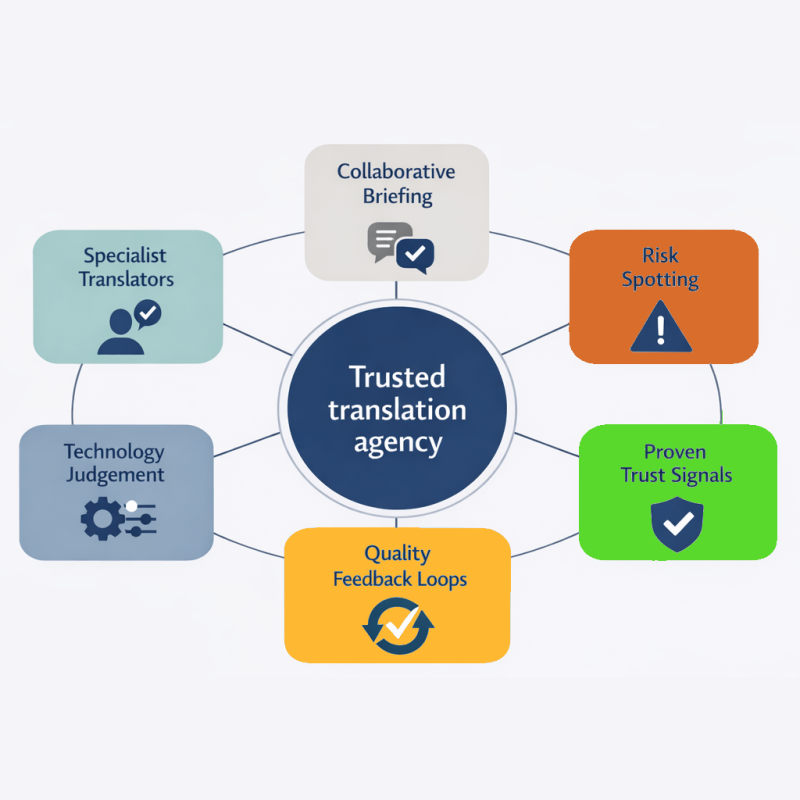
At its core, a strong agency works with qualified, sector-specialist translators, communicates clearly and builds a collaborative briefing process from the start. But beyond that, the real differentiator lies in how those elements are aligned.
With over 20 years of experience, we’ve seen where projects succeed and where risks typically begin to surface. In this guide, we’ll walk through what to look for in a translation agency and provide a checklist to help you make the right choice.
What does a translation agency actually do?
On the surface, a translation agency converts content from one language into another.
But in practice, a good agency does much more than that.
A strong agency will:
- Ask for client input and talk through the brief
- Work with specialist, qualified linguists – not generalists
- Provide detailed briefs to linguists so they understand the content, audience and approach
- Adapt content for cultural and market relevance where necessary
- Follow industry and customer-specific terminology
- Manage projects across multiple languages, timelines and stakeholders
- Build in structured quality assurance at every stage
- Identify risks before work begins – not once issues arise
- Have the expertise to field linguists’ questions and keep decisions aligned
- Be proactive and engage with you and your in-country teams
In effect, the agency becomes an extension of your team – particularly when complexity increases.
Why the right agency matters
Many providers can deliver a translation; fewer can manage what sits behind it.
Consider a typical scenario: you need content translated into 10 languages. That’s not just 10 outputs – it’s 10 workflows running in parallel, each requiring alignment, review and coordination.
Without the right structure in place, small issues compound quickly:
- Delays in one language impact the wider rollout
- Inconsistent tone weakens brand messaging
- Reviewer availability becomes a bottleneck
- Last-minute fixes increase cost and risk
This is where the right agency becomes essential: not simply supplying translations, but managing complexity for you and reducing the burden on your team.
A closer look: When coordination becomes critical
The value of an agency is often most visible in the work that prevents problems from reaching the client. Take a global product launch, for example. The brief may appear straightforward at first: translate campaign content into multiple languages by a fixed deadline.
But as the briefing develops, the risks start to become clear.
What looks like a translation task is really a coordination challenge. Each language needs the right translator, reviewer, terminology and timing, while queries will need to be answered quickly so decisions remain consistent across every market. If one stream stalls, it can affect the wider rollout.
From the outset, we map the workflow in detail, identifying pressure points around translation and revision capacity, consistency and approval. We also build in contingency plans, including backup linguists who are already familiar with the brief. As a result, we’re prepared and can maintain continuity as well as keep the project moving and the timeline intact should a linguist become unavailable midway through the project.
From the client’s perspective, the process stays calm and controlled. The project runs smoothly, deadlines are met and messaging remains consistent across all markets. This kind of behind-the-scenes reliability gives clients confidence that the agency can handle pressure without creating extra work for their team.
What to look for in a translation agency: a practical checklist
1. Professional translators – not just language coverage
Quality starts with people. Look for agencies that:
- Work with native, specialist translators
- Match linguists to subject matter
- Avoid over-reliance on raw machine translation – it does happen and can cause costly mistakes.
This is your baseline for accuracy and credibility.
2. A relationship-led approach
This is often the biggest differentiator. Strong agencies:
- Take time to understand your business and audience
- Ask questions – not just accept briefs at face value
- Provide input and critical perspective where needed
You shouldn’t feel like you’re handing work over – you should feel supported by a team that understands your expectations, remembers previous decisions and can carry that knowledge into future projects.
3. A structured, collaborative briefing process
Most translation issues originate at the start – not the end. A good briefing process will:
- Clarify tone, intent and audience
- Identify where content may need adaptation
- Flag risks early, before work begins
If your agency isn’t asking detailed questions, that’s a warning sign.
4. A realistic understanding of technology
Translation technology and AI can be powerful, but they are not universal solutions. The best agencies:
- Use tools to support consistency, efficiency and terminology control
- Understand when machine translation, AI-assisted workflows or human translation are appropriate
- Know where human input is critical for nuance, brand voice, cultural relevance or higher-risk content
- Address limitations early in the workflow, rather than treating technology as a shortcut
The goal isn’t to use more technology – it’s to use the right level of technology, review and human expertise for the content, audience and risk involved.
5. Continuous quality and feedback loops
Quality doesn’t happen in a single step – it evolves over time. Look for agencies that:
- Build in revision and proofreading as standard
- Capture client feedback after delivery
- Apply learnings to future work
This is how consistency improves – and why long-term partnerships deliver better results.
6. Evidence of trust and experience
Experience matters – but the strongest evidence is usually found in how clients continue to work with an agency over time.
Rather than looking only for broad claims about quality, pay attention to the patterns behind the agency’s work:
- Clients who return for new projects or content types
- Teams that recommend the agency internally because the process is reliable and they like the way the agency works
- External referrals from people who have seen the agency’s work first-hand
- Relevant testimonials, recommendations or project examples that show how the agency performs in practice
You may also want to ask whether the agency follows recognised translation quality standards, such as ISO 17100, and how those standards are reflected in its everyday workflow – from translator selection and revision to feedback management.
These signals show that trust has been earned through repeated delivery, not just promised at the point of sale.
Don’t just ask what they deliver – ask how they make decisions
Most agencies will meet at least some of these criteria, but the real difference lies in how consistently those qualities come together in practice.
The strongest agencies do more than follow a process; they notice potential risks before they become problems, guide decisions when there is uncertainty and take responsibility for the outcome rather than simply delivering the requested files.
That is when the quality of the relationship becomes clear. Under pressure, the agency’s communication, planning and problem-solving either hold the project together or leave your team reacting to issues as they arise. Over time, those day-to-day behaviours become the real proof of reliability: the reason teams come back, expand the relationship and recommend the agency to others.
Choose the agency you trust to decide with you
If you don’t have expertise in the target languages, you’re not just outsourcing work – you’re delegating judgement.
Those decisions cover everything from linguistic accuracy and brand tone to managing risk across multiple markets.
The right agency recognises that responsibility and shapes its process around it. At this stage, you are not simply choosing a supplier – you’re choosing a partner you can trust to make the right calls when they matter most.
If you’re reviewing translation options – or want a second opinion on your current setup – we’d be delighted to talk through your requirements.
